Data Privacy
ITA-Maskit
A local audit-data protection workbench that connects two processing engines, maintainable rules, and deterministic pseudonymization with preview and audit trails.
- Project scope
- CLI + Windows desktop app
- Current status
- Completed
- My role
- Independent developer
Technology
- Python
- Polars
- PyQt5
- YAML rules
- Deterministic pseudonymization
What it solves
Audit material often combines tables, JSON, email, PDF, and Word, where manual processing can miss sensitive values and break the relationship between the same person or employee identifier across files. ITA-Maskit connects rule selection, hit preview, local processing, and versioned audit records so that necessary joins survive while source values leave the original files.
Core capabilities
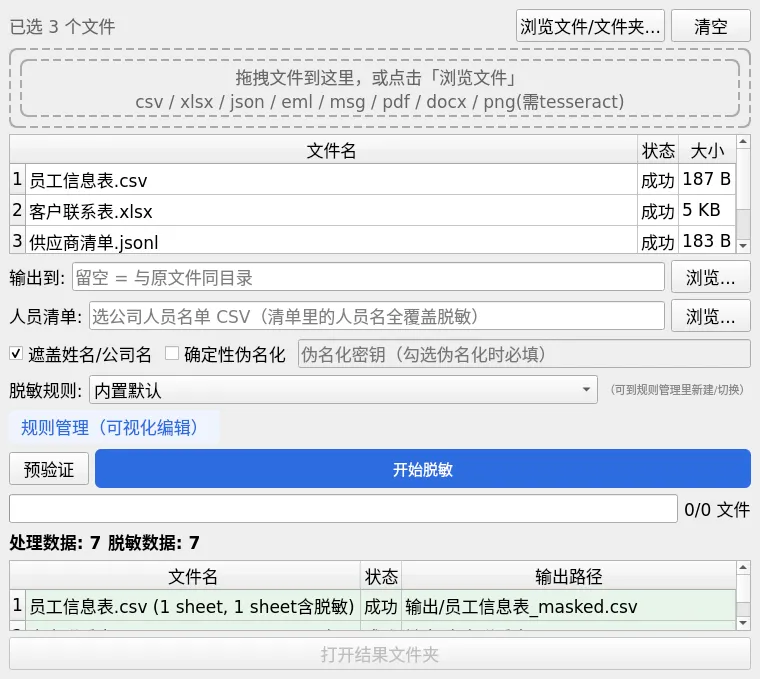
- Select rules and batch-process files through the CLI or Windows GUI
- Process tables, JSON, email, PDF, and Word locally
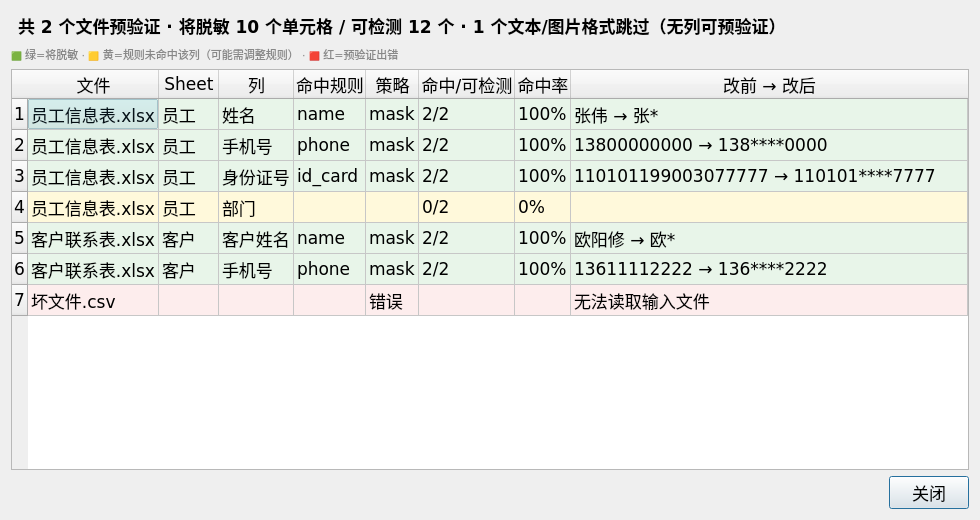
- Preview rule matches and sample changes before writing output
- Choose masking or deterministic pseudonymization
- Use personnel lists to improve name and employee-ID matching
- Inspect statistics, output locations, and versioned audit logs
How it works
- Select files, a rule set, and optional personnel data
- Preview matches without writing output
- Execute masking or deterministic pseudonymization locally
- Inspect statistics, output paths, and the audit log
Users select files, rule sets, and personnel lists through the CLI or Windows GUI. The workbench previews rule matches and sample changes before it writes anything, then processes the batch locally; statistics, output locations, and versioned audit logs stay within the same processing boundary.
Project highlights
Cover tables and documents with two processing engines
The column-based table engine applies rules at field boundaries for tabular data, while the full-text document engine scans JSON, email, PDF, Word, and similar material. Both paths run locally and reuse the same preview and rule decision, keeping cross-format audit batches inspectable.
Turn masking policy into maintainable data
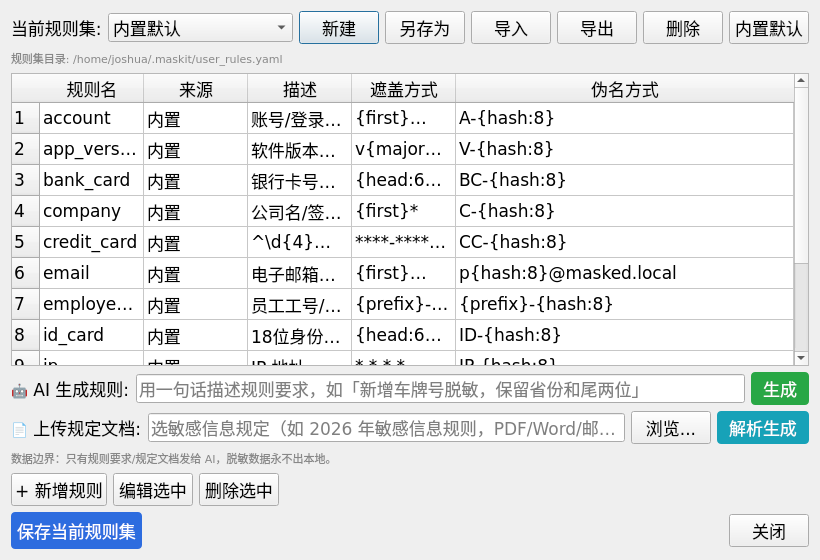
YAML stores field mappings, match strategies, masking templates, and pseudonymization templates while rule versions remain separate from processing code. A business-policy change updates validated data configuration; preview and formal execution reuse that same version to reduce rule drift.
Preserve cross-file joins without exposing source values
Inputs are normalized according to field strategy before a user-supplied pepper participates in domain-separated HMAC. The same normalized value therefore receives a stable deterministic alias across files, while personnel lists can improve name and employee-ID matching; source values are not exposed as aliases, and the pepper remains runtime configuration.
System architecture
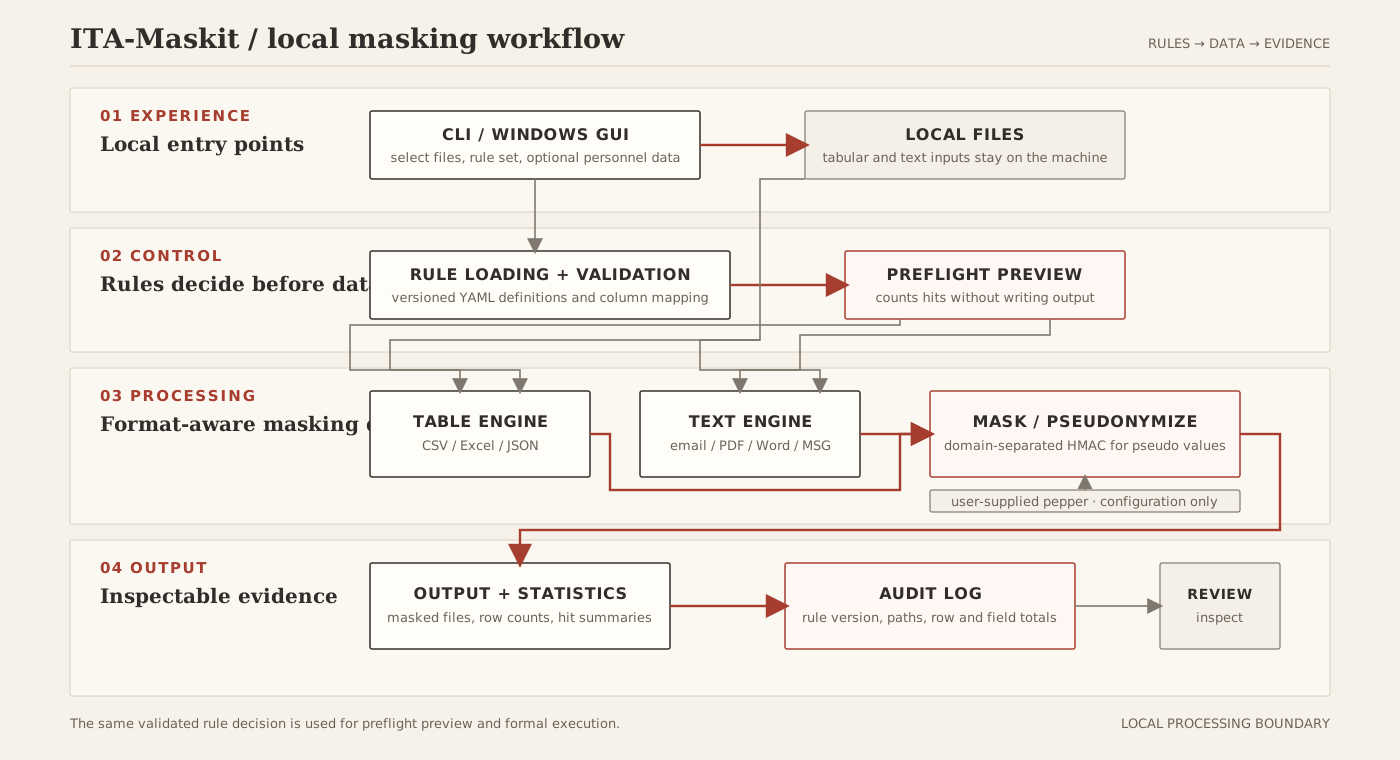
The same rule version drives preview first, then routes files through the column-based table engine or full-text document engine. Masking or deterministic pseudonymization produces the output, statistics, and versioned audit log locally, without sending audit material to an external service.
Project scope
This is a local audit-material processing tool, not a claim of certification or a replacement for deployment-level access control, key management, or encrypted storage; screenshots use scripted demonstration data from the repository. Deterministic pseudonymization is not encryption, and image OCR and layout-preserving PDF masking remain beta.